OKRs are the framework everyone talks about now. Ask most people under forty what a strategy tool looks like and they'll describe an objective and three key results, not four perspectives and a strategy map. I use OKRs constantly, and I've written more than once about how to write them well. But I still open every engagement with the Balanced Scorecard, and I don't think that's a nostalgia habit. I think it's the part of the work OKRs were never built to do.
OKRs are a format. They're not a map.
An OKR is a very good way to express an intention clearly: here's the outcome, here's how we'll know we got there. What it doesn't do is tell you which outcomes deserve that treatment in the first place. Nothing about the OKR format stops a leadership team from writing five sharp, well-formed objectives that are all, quietly, about the same thing — usually growth, usually the loudest problem in the room that quarter — while something slower-moving and just as important goes completely unaddressed because nobody was prompted to look there.
That's not a writing problem. A badly-scoped OKR and a well-scoped one can both suffer from it equally, because the format has no opinion about coverage. It only has an opinion about clarity.
What the four perspectives actually do
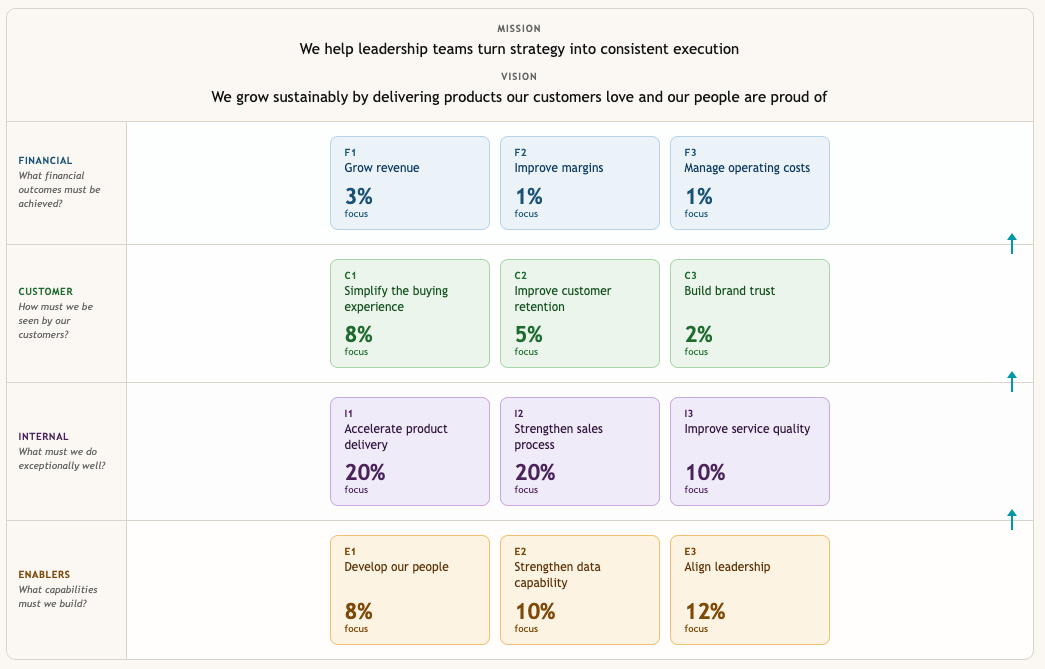
The Balanced Scorecard's real contribution, underneath forty years of consulting-deck packaging, is a simple discipline: before you write down what you're going to do, name the four different lenses a business has to be healthy through at once. Financial outcomes. How you're perceived by the people who pay you. What you have to be excellent at internally to deliver on that. And what you're building — capability, people, systems — so you can still be doing this well two years from now.
At Keel we don't call them by Kaplan and Norton's original labels, and the exact words matter less than the discipline behind them. What matters is that a leadership team can't finish the strategy conversation having only talked about revenue. All twelve boxes are sitting there waiting for a number, until someone has to decide how much each one actually deserves.
Why this order matters in practice
This is why, in a Keel session, the strategy map always comes before a single OKR gets written. The map forces the argument about balance — where does focus actually go this period, across all four lenses, not just the one the CEO walked in already thinking about. Once that argument has happened and the group has committed to a weighted set of priorities, OKRs become the natural next question: given what we just agreed matters, what will we actually do about it, and how will we know it worked.
Try to skip straight to OKRs without that step, and you get objectives that are individually well-written and collectively lopsided — a pile of good intentions with no guarantee they add up to a business that's healthy on every dimension it needs to be.
The map doesn't disappear once the OKRs are written, either. Because it's simple enough to hold in your head — four rows, twelve boxes, one weighting each — it becomes something a team can genuinely glance back at mid-quarter, not just a document built once and filed away. "Are we still spending our attention the way we said we would" is a much easier question to ask of a single page than of a dozen separate OKR trackers.
The caricature isn't the framework
The usual case against the Balanced Scorecard is that it's heavy — an annual boardroom exercise, built for organisations with dedicated strategy functions and the patience for a slow cascading process. That criticism is fair against how it's often been implemented. It's not a property of the four-perspective idea itself. Naming four lenses and asking a room to argue about where effort goes across them can happen in an afternoon. The bureaucracy was never required; it just accumulated.
I still use the Balanced Scorecard's structure because it answers a question OKRs can't ask themselves: are we even looking in the right places. Everything after that — the sharp, well-written, accountable objectives — is real, necessary work. It's just not the first question.