Most criticism of OKRs is really criticism of how badly they're usually written or how loosely they're followed up on. Fix the writing, run the reviews, and the framework gets the credit it deserves. That criticism is fair, but it misses something underneath it: even a well-run OKR programme, done properly, hits a wall — not because anyone did it wrong, but because there's a level of decision it was never built to make.
What a good OKR rollout actually does well
Run properly, an OKR process answers a question leadership teams are surprisingly bad at asking themselves: is what we're currently doing actually connected to a strategic outcome, or has it just always been done? Most organisations carry a long tail of activity that nobody set out to justify — it was reasonable once, it never got cancelled, and it quietly keeps consuming time and attention. A real OKR conversation, where objectives are argued over rather than rubber-stamped, surfaces that tail fast.
The relevance test itself is useful. The more valuable half of it is what it makes possible: stopping things. Naming what to abandon is harder than naming what to pursue — organisations are structurally much better at starting work than admitting that something already running should end, because starting is optimistic and stopping looks like failure. A good OKR process gives a team the cover and the evidence to stop something out loud, in a room, with the reasoning on record. That's disproportionately more valuable than the goal-setting exercise itself.
The second thing a good rollout does is break down silos. Most strategic priorities that actually matter can't be delivered by one department alone — they need marketing, product, and operations genuinely pulling in the same direction, not just reporting progress to each other in a shared document. A visible, shared set of objectives makes each function's contribution to the same outcome legible instead of assumed, and that visibility is precisely what turbo-charges the hardest cross-functional projects — the ones that die quietly in the gap between departments when nobody's watching that gap.
Where OKRs run out of runway
An OKR answers a yes-or-no question about a single initiative: is this connected to something strategic. It doesn't answer a comparative question about many initiatives at once: given everything that passes that test, which ones get the people and the budget this quarter, and in what order?
Imagine a leadership team that's done the work properly. They've named their real strategic priorities, they've stopped the activity that doesn't connect to them, and they're left with — realistically — somewhere close to a hundred potential projects and initiatives that all genuinely tie back to a strategic objective. Every one of them would pass an OKR alignment check. None of them is the wrong answer to "is this strategic." But nobody has the budget or the people to run all hundred this quarter, and OKRs give you no mechanism for choosing between them, because relevance was never the axis that separates them. Cost, capacity, sequencing, and expected return are different axes entirely, and a framework built to test relevance doesn't measure any of them.
This is where a lot of OKR programmes quietly default back to whoever argues loudest in the room, or to last year's budget with new labels on it — not because the team did OKRs badly, but because they've reached the edge of what OKRs were designed to do and kept trying to use the same tool past that edge.
This is a portfolio problem, not an OKR problem
The good news is that the work already done to get to this point isn't wasted — it's the raw material for the next layer, not a separate exercise. The same weighted strategic priorities a team argued over to set their OKRs get reused as the scoring basis for every candidate project: how strongly does this specific initiative contribute to the priorities already agreed on, and how much does it actually cost in people, money, and time to deliver. A leadership team ranks which of those three constraints is genuinely tightest for them right now — is headcount the real ceiling, is it budget, or is it the calendar — and that ranking changes how every project's resource cost gets weighted.
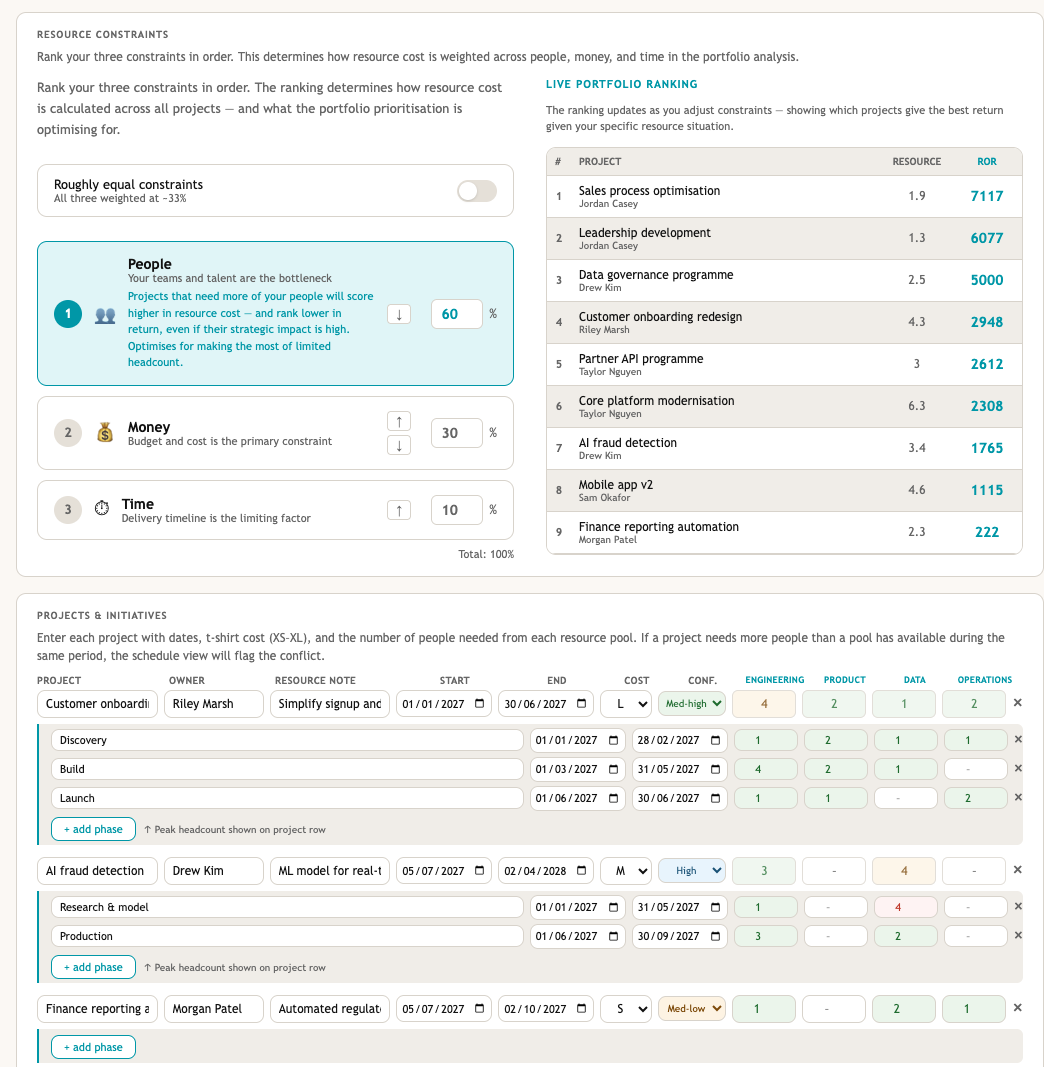
What falls out is a ranked list, not a gut feeling. In one real working session, "Sales process optimisation" topped the list with a return-on-resources score of 7,117, needing a relatively light 1.9 units of resource for the strategic weight it carried. "Finance reporting automation" sat at the bottom of the same list — a perfectly legitimate, strategically-connected project — with a score of 222. Both would sail through an OKR alignment check. Only one of them is obviously worth doing first.
Ranking alone still isn't the whole picture, because a project can look attractive on paper and still be undeliverable given what a team has already committed to. Laying the same projects across actual team capacity, quarter by quarter, surfaces the second half of the problem: not just what's worth doing, but whether there's room to do it.
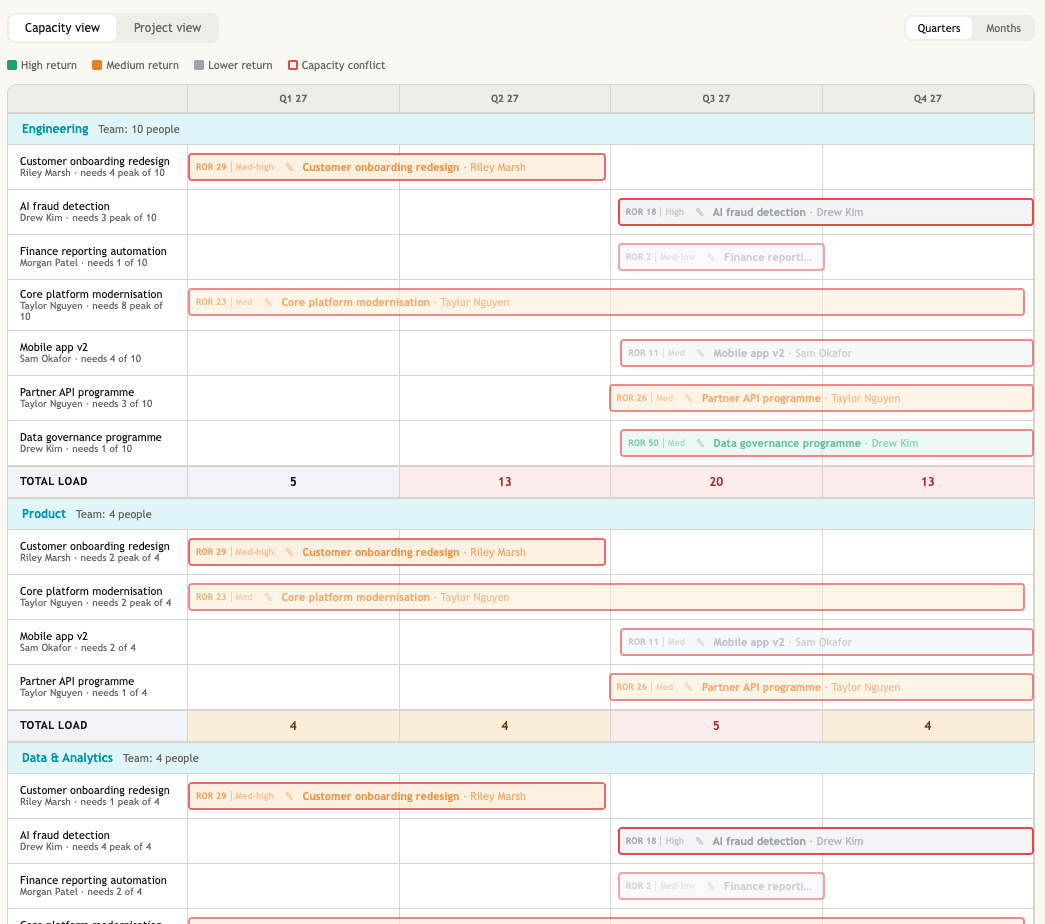
That combination — a ranked return on resources, checked against a team's real, finite capacity — turns "we have a hundred good ideas" into an answer a leadership team can actually defend: this is what we're funding, this is why, and this is what we're deliberately not doing yet.
None of that replaces the OKR conversation. It picks up exactly where OKRs hit their ceiling — after relevance has been established and the silos have come down, when the real question stops being "is this strategic" and becomes "which of our many strategic options deserves the people we actually have."